Ria Formosa Natural Park: The Wild Side of the Golden Triangle
You know that wooden footbridge at Quinta do Lago, the one everyone trudges over to get to the beach? Walk over it. Now look back. Where you just came from is technically the edge of a protected nature reserve. Bet nobody told you. There's no sign about it, no welcome board, no park ranger asking for tickets. People march across it in flip-flops every morning, totally unaware they're stepping into one of Europe's most important wetland systems. Which, in case you're curious, runs about sixty kilometres east along the coast from where you're now standing.
Stay in a villa in the Golden Triangle and that's all on your doorstep. Here's a 30-second video so you can see what we mean before we go any further.
What is the Ria Formosa Natural Park?
The textbook answer is a coastal lagoon system. Which is true, but pretty thin.
Better answer: 18,400 hectares of saltwater channels, dunes, marsh and barrier islands, with the lot of it draining and filling twice a day on the tides. The west end picks up at Ancão (basically the back of Quinta do Lago). Sixty kilometres later, the east end stops at Manta Rota, just shy of the Spanish border. Five barrier islands sit between you and the open Atlantic, plus two peninsulas, all keeping the lagoon protected behind them.
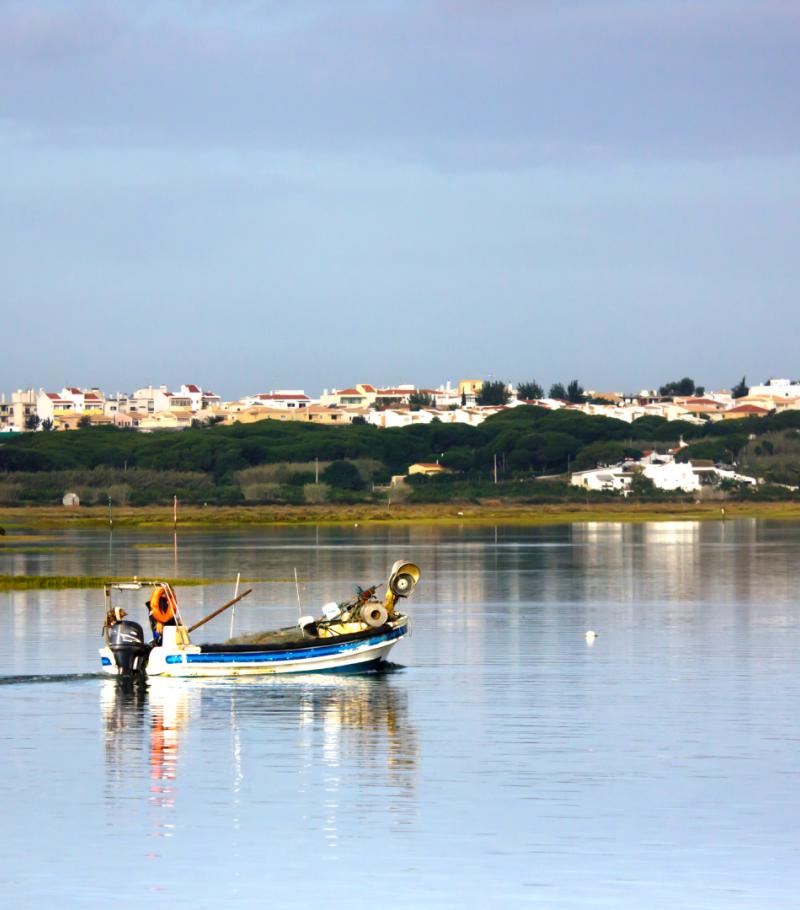
Surprises people, this next bit: it's not a wilderness. Or not in the way you'd picture. Fishermen live and work on the islands. The same families have been here for generations. Down at low tide you'll see oyster and clam farmers in the channels, working the same beds their grandparents worked. The salt pans on the inland side have been producing salt continuously for, well, forever really. Two thousand years and counting, give or take a war.
The São Lourenço Trail (start here)
If you do one thing inside the park, do this one. Easiest to reach, biggest payoff for the effort, free, no booking, no tickets. You walk in.
3.5 kilometres. Ninety minutes if you push through. Two hours once you slow down, which you should. Out of Quinta do Lago first, through the stone-pine woods, which smell like a good cup of tea after rain (one of those weird local things you only notice once someone points it out). Past a couple of small freshwater lagoons. Then onto the boardwalks across the salt marsh, which is where the bird hides start. These are wooden huts on stilts, viewing slits cut into the wall planks, a single bench inside. You sit. You wait. Something always turns up.
What you see swings hard with the season. The purple swamphen is the year-round bird, and the park's mascot. A hefty blue-purple thing, three times bigger than the photos make it look. Once you've clocked one, you'll start seeing them in every reed bed. Egrets too. White, all year, dotting the channels.
Flamingos are the autumn-winter event. They turn up in October, stand in the shallows on one leg like they've forgotten the other, and stick around till spring. Total scene-stealers.
Then spring kicks the migration up a gear. Spoonbills come through, white storks, avocets, dozens of smaller waders we couldn't ID confidently if pushed. The flyway between northern Europe and Africa runs straight over the park, so spring and autumn are when birders book flights specifically to be here. Around 200 species recorded total, depending on whose count you trust.
We should mention: there are Mediterranean chameleons in the dunes and otters in the channels at dusk. The chameleons being chameleons, we wish you good luck. The otters tend to mind their own business.
One thing. Go early. Light is better, birds more active, and from May onwards the mid-morning heat takes the fun out of it.
Which Ria Formosa island is best to visit?
Wrong question, really. The five barrier islands are different beasts and the "best" one is the one matching the kind of day you want.
Ilha Deserta (proper name Ilha da Barreta) is the wild one. Deserted, mostly, hence what everyone calls it. Walk down to the very tip and you'll find a small wooden post in the sand. That's Cabo de Santa Maria, the southernmost point of mainland Portugal, which is a slightly arbitrary thing to make a fuss of but you might as well. There's one restaurant on the island, and it's better than it has any right to be. Prawns from the lagoon, fish off the grill, simple stuff done well. Bring water and sun cream though, you won't find much else. Boats come from Vilamoura Marina (we covered the operators in our boat tours guide) and also from Faro.
Ilha da Culatra is the lived-in opposite. Working fishing village, around a thousand people, generations of the same families. Whitewashed houses on sandy lanes (no roads, no cars), a few restaurants, miles of empty beach stretching off in both directions. Ferry from Olhão, half an hour, feels like a proper boat ride.
For most Golden Triangle guests, Ilha Deserta is the obvious one. Full day from Vilamoura, lunch on the island, cruise back. Don't feel obliged to do both islands. Either one alone gives you a feel for the place.
Kayaks are the other route in. Hire from Faro or Olhão and paddle through the inner channels that boats can't reach. No engine noise, so the herons and egrets don't fly off the second you appear. Lagoon water is flat. Beginners are fine. Two hours, done.
When is the best time to visit the Ria Formosa?
Depends entirely on what's pulling you out there.
If it's the wildlife you're after, spring and autumn are the strongest months. Migration's at its peak, the heat won't kill you, and the bird variety is at its widest. October through to early spring is when you'll see the most flamingos.
Summer's fine for the boats, the beaches, the islands. Just don't try walking the trails after about 10am or the sun will do you in.
Winter's the one that gets skipped, which is a shame. Algarve climate stays mild all the way to January, the resident birds are easier to spot without all that summer foliage in the way, and the São Lourenço Trail is yours alone most days.
The park itself doesn't shut. No gates, no admission, the trails are open whenever. Boat operators thin out their winter schedules but most still run, especially weekends.
A few practical bits before you go. Bring binoculars; phone zoom is useless for birds at any distance. Wear closed shoes; the boardwalks get slippery after rain. Book Ilha Deserta in July and August or you'll miss out, the boats fill up. And if you want a bit of context, swing by Quinta de Marim, a small visitor centre just outside Olhão. Half an hour with the exhibits and the rest of the park starts making more sense.
Why this is worth knowing if you're staying in the Golden Triangle
Because the park sits right where you're sleeping. The back boundary of Quinta do Lago is the park's western edge. Vale do Lobo falls inside its broader catchment. Vilamoura's marina, where the boats leave, is fifteen minutes by car.
Most of you come here for the golf, the beaches, the long lunches, the villa-and-pool setup. Fair enough, those are the main events. The Ria Formosa is the bit underneath: the morning walk on the São Lourenço Trail before anyone else is up, the slow day on a boat out to Ilha Deserta, the dawn kayak through the inner channels with a thermos of coffee. The brochure doesn't tell you about any of this. Now you know.
Browse our villas in the Golden Triangle.